


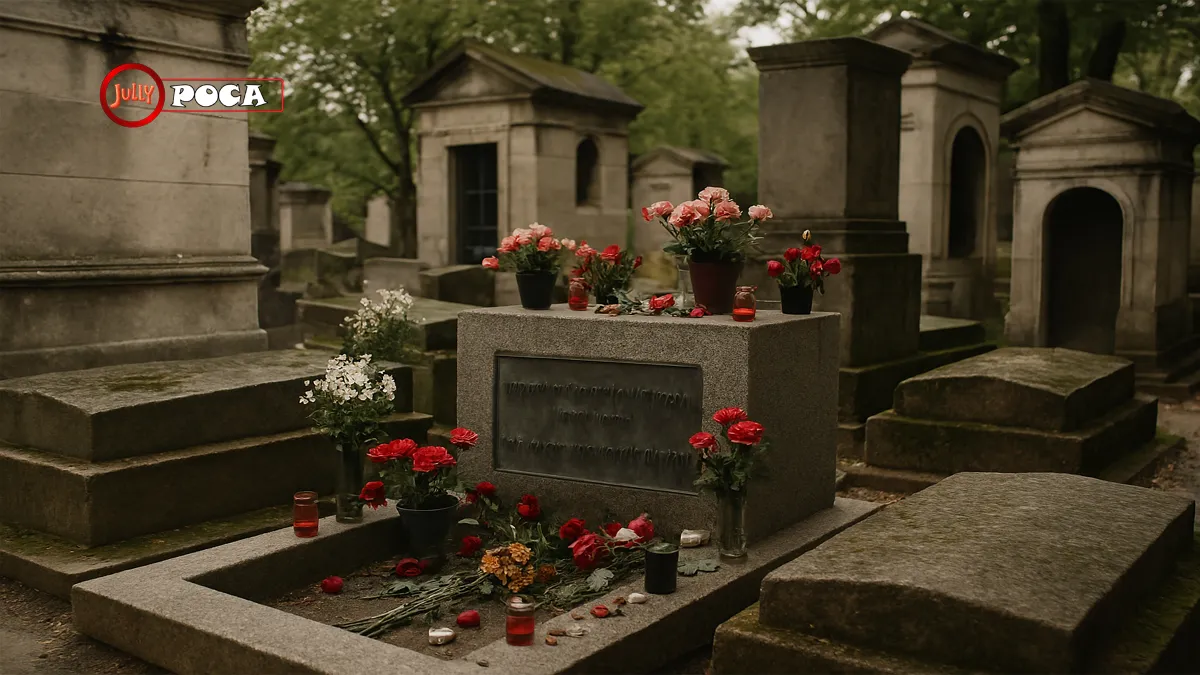
Walking through Paris, it is easy to feel the past around you. Yet few places mix poetry, rebellion, and grief like the jim morrison grave in Père Lachaise Cemetery. 🌹
Fans arrive from every continent. Some carry flowers. Some bring a worn copy of The Doors on vinyl. Others come with nothing but questions about life, death, and creativity.
They often ask the same thing: where is jim morrison buried, exactly? How did a California rock star end up in a quiet Paris cemetery corner, far from Los Angeles and the Sunset Strip?
This article explores seven vivid, human stories linked to the tomb of Jim Morrison. Each story reveals not only facts, but emotions. You will see how one modest grave became a global symbol of freedom, excess, and art. ✨
1. How the Jim Morrison Grave Became an Unlikely Pilgrimage Site
When Jim Morrison died in Paris in July 1971, the moment passed almost quietly. There was no massive funeral. No public procession. Just a small circle of friends and his partner, Pamela Courson.
His burial at Père Lachaise was, at first, low key. The cemetery already held names like Oscar Wilde, Frédéric Chopin, and Edith Piaf. Jim was only another new resident, placed in a simple plot.
Yet within a few years, something unexpected happened. The jim morrison grave drew more visitors than many of the great European artists buried nearby.
From modest plot to global destination
At first, there was barely a marker. No big statue. No elaborate tomb. Travelers had to ask staff for directions, or wander the winding paths.
Fans slowly began to share stories:
- A backpacker from Spain who got lost and found the grave by following the faint sound of a cassette player.
- A student from the United States who cried when she saw fans reading Morrison’s poetry beside the headstone.
Word spread through:
- Rock magazines
- Early fan newsletters
- Later, travel guides and websites
Père Lachaise turned into a musical pilgrimage map. People started including Jim’s plot alongside famous graves, planning their whole Paris visit around it.
Why his grave touched so many
For many visitors, the site feels personal. They remember:
- Hearing Light My Fire as teenagers
- Reading Morrison’s lyrics during hard moments
- Seeing him as a symbol of defiance and vulnerability
So they come not only to see a grave. They come to say thank you, or to seek comfort. The burial site becomes a mirror for their own lives, regrets, and hopes. 💔
2. The Mystery of the Original Jim Morrison Grave
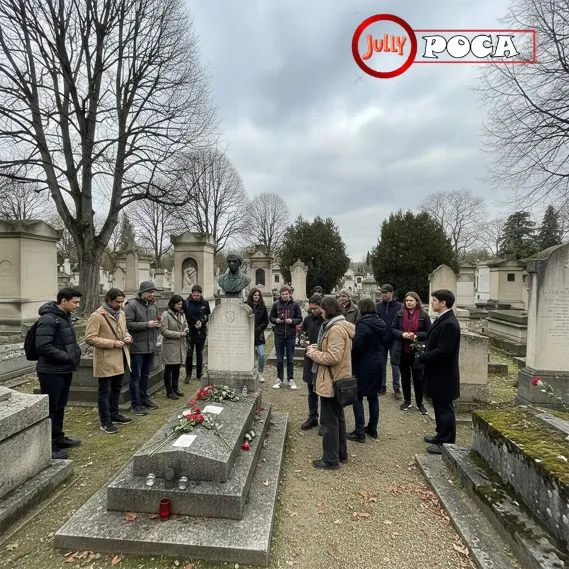
Many fans are surprised to learn that the original jim morrison grave looked very different from today’s site.
A simple beginning
In 1971, Jim’s grave was a plain spot with a simple marker. No bust. No protective barriers. Early visitors described it as almost hidden.
Some early accounts mention:
- A basic plaque with his name
- A small patch of ground, easy to miss
- Few signs that a rock legend rested there
This modest start helped create a sense of intimacy. Those who found it in the 1970s felt they had discovered a secret.
How the site changed over time
As more fans arrived, the grave evolved. The area saw:
- More flowers and candles
- Handwritten notes tucked into cracks
- Bottles, photos, and small personal objects left behind
Eventually, the cemetery and Morrison’s family made changes:
- A new marker was added.
- Nearby tombs were cleaned and repaired.
- Pathways were adjusted to manage the growing crowds.
The original jim morrison grave no longer looks as it did in 1971. Yet many early photographs and memories survive. They show a quiet corner of the cemetery, touched gently by a small group of devoted fans.
Confusion and misdirection
For years, visitors often struggled to find the exact location. Map copies were poor. Some guides gave wrong directions. People asked in many languages, “Where is Jim’s grave?”
Stories spread of:
- Tourists walking in circles for hours
- Fans discovering the plot only at closing time
- Visitors forming small search groups with strangers
In a way, this confusion added to the myth. The search became part of the experience. 🚶♂️🌲
3. “Where Is Jim Morrison Buried?” – Navigating Père Lachaise
If you arrive at Père Lachaise today, you might still feel a little lost. The cemetery is a maze of paths and centuries-old graves. Many visitors still ask where is jim morrison buried before they even pass the gates.
The official answer
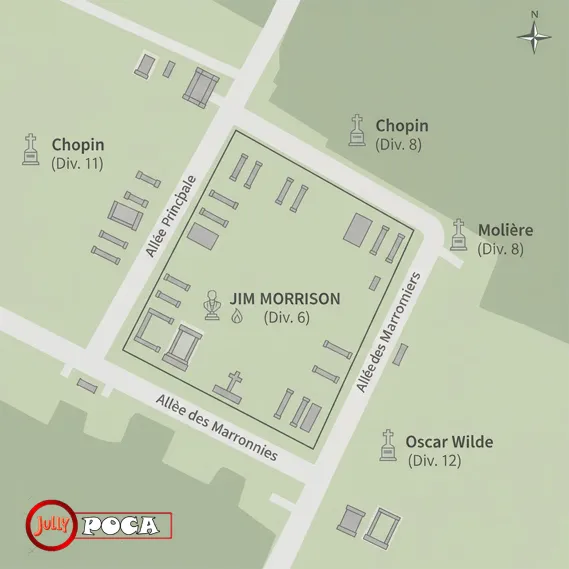
Jim Morrison is buried in Division 6 of Père Lachaise Cemetery. His grave is not on a main road. You walk narrow paths between older family tombs. These stone structures sometimes lean and crack with age.
A practical route usually looks like this:
- Enter through one of the main gates.
- Pick up or download a cemetery map.
- Look for Division 6, near the south-central area.
- Follow small signs or ask staff for help.
Why the search still matters
Even with digital maps, many people still wander. They stop to admire other tombs, reflect, and talk. This slow, uncertain search sets a thoughtful mood.
Visitors often report:
- Striking up conversations with strangers
- Sharing memories of Doors songs
- Helping older travelers navigate uneven paths
By the time they reach the tomb of Jim Morrison, many feel they have already walked through a small history lesson. The cemetery’s silence prepares them for the emotional weight of the grave itself.
A quick guide to Jim Morrison’s burial facts
Here is a short overview to help place the grave in context:
| Detail | Information |
|---|---|
| Cemetery | Père Lachaise, Paris |
| Division | 6 |
| Year of burial | 1971 |
| Style of grave | Simple stone plot with surrounding tombs |
| Nearest famous neighbors | Edith Piaf, Oscar Wilde (different divisions) |
| Typical visitor experience | Quiet reflection, photos, offerings, short stay |
This simple layout reflects how Jim’s presence blends with the older, more traditional tombs nearby.
4. Graffiti, Vandalism, and Fan Art Around the Tomb of Jim Morrison
The tomb of Jim Morrison has seen many forms of expression. Some are moving and respectful. Others have caused real damage.
The first waves of graffiti
In the 1970s and 1980s, fans began leaving messages:
- On nearby tombs
- On trees and walls
- On the stone around Jim’s plot
Some wrote lyrics. Others carved hearts and names. A few spray‑painted entire surfaces. Many believed they were honoring his rebellious spirit.
Yet this created serious issues:
- Families of neighboring graves felt hurt.
- Cemeteries are still sacred spaces in France.
- Staff faced constant cleaning and repair work.
The tension between tribute and respect
This tension remains a difficult topic. Many fans want to leave a trace. They feel inspired by Morrison’s wild image and poetry. Yet the cemetery demands quiet respect.
The most thoughtful visitors now show care in different ways:
- Leaving biodegradable flowers
- Placing small notes that can be removed easily
- Standing in silence and simply reflecting
A gentle, respectful approach protects both Jim’s memory and the resting places of others.
From vandalism to curated memory
Over time, local authorities and Morrison’s family took steps:
- Barriers were added to keep fans at a short distance.
- Frequent cleaning of nearby graves began.
- Signs reminded visitors of cemetery rules.
Today, fan art appears more on posters, online projects, and personal journals. Many people still feel inspired. They simply express that inspiration away from fragile stone surfaces. 🎨
5. The Stolen Bust and the Mythic Aura of the Grave
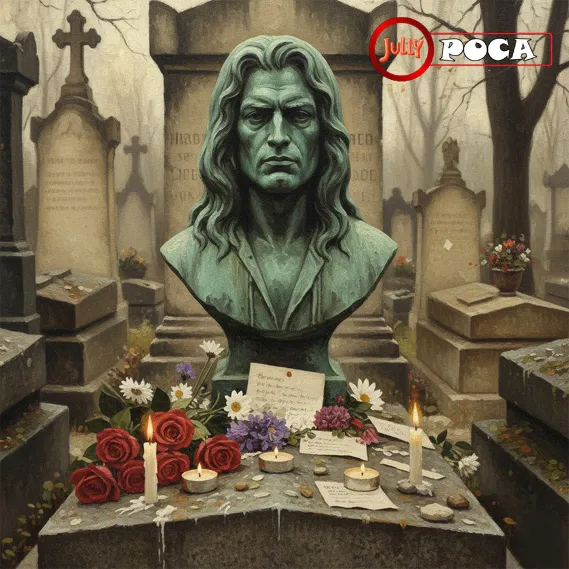
One of the most famous objects connected to the grave was a bronze bust of Jim Morrison. Its story has become legend among visitors.
The arrival of the bust
In the early 1980s, a sculpted bust of Jim appeared at his burial site. It showed his head and shoulders, eyes closed, hair loose. The sculpture quickly became a focal point.
Fans treated it almost like a shrine. They:
- Touched the metal for luck
- Kissed the surface, leaving lipstick marks
- Placed flowers on the shoulders
Photos from that time show a very different atmosphere. The bust gave the site a strong visual center, like a small outdoor statue.
The mysterious theft
Then, the bronze bust vanished.
Sometime in the late 1980s, unknown individuals removed it. Rumors flew:
- Some said it was taken by a fan.
- Others suspected metal thieves.
- A few even imagined it was removed by authorities.
The truth remains unclear. The loss added another layer of myth. The missing bust feels like a symbol of Morrison himself: present yet distant, visible yet elusive.
Life after the bust
Even without the sculpture, the grave’s aura stayed strong. The jim morrison grave now appears simpler again. Visitors focus more on the stone, the flowers, and the messages left by others.
Many fans say the missing bust reminds them that nothing material lasts forever. What remains is the music, the words, and the shared moments at the site.
6. Security, Fences, and the Modern Jim Morrison Grave Experience
As the grave attracted more visitors, practical issues grew. Noise, litter, and damage forced the cemetery to act. This changed how people experience the site today.
Why barriers were added
Authorities placed a small fence and clearer boundaries around the grave. The goals were simple:
- Protect the stone from being climbed on
- Reduce graffiti and damage
- Keep pathways safe and accessible
Some fans felt disappointed at first. They imagined a wild, open space. Instead, they discovered a modest grave behind a low barrier, often watched by staff.
Yet many later understood the need. Without these steps, the jim morrison grave might have suffered far worse damage.
The mood around the grave today
If you visit now, you will likely find:
- A generally quiet crowd
- People taking turns at the front
- Many visitors staying only a few minutes
You might hear a quiet song played from a phone. You might see someone reading a short poem. The atmosphere often feels like a calm, shared vigil. 🙏
Practical tips for visitors:
- Arrive early in the day for fewer crowds.
- Keep voices low near the grave.
- Avoid leaving objects that could harm the environment.
By treating the site gently, visitors help preserve it for others yet to arrive.
Balancing legend and everyday reality
The modern experience of the grave is less wild than the stories suggest. Yet this contrast can be healthy. It shows that remembrance can be peaceful, not only dramatic.
Visitors often leave with two truths:
- The legend of Jim, filled with intensity.
- The reality of a simple grave, in a quiet Paris corner.
Both truths can coexist.
7. Myths, Conspiracies, and the Question of Whether He Is Really There
No famous grave seems complete without rumors. Jim Morrison’s resting place is no exception. Over the decades, many conspiracy theories have surrounded his burial.
“Is he really buried here?”
Some fans claim Jim faked his own death. Stories describe him living in hiding, perhaps in the United States or North Africa. These tales usually lack evidence, yet they spread easily.
Common themes include:
- The death was staged to escape fame.
- The body in the grave is not Jim’s.
- Jim still writes poetry somewhere, in secret.
There is no credible proof for these theories. Yet they continue, fueled by Morrison’s mysterious public image.
What the records say
Official documents and witnesses confirm his death in Paris in 1971. He was buried at Père Lachaise shortly afterward. Testimonies from friends support this narrative.
Why the myths persist
People often struggle to accept the death of a young, charismatic figure. Myths can reflect:
- A wish that he somehow escaped tragedy
- A refusal to let go of a powerful cultural symbol
- A need to keep the story open, not closed
Standing at the tomb of Jim Morrison, some visitors whisper these questions. But many find another perspective. They choose to honor his work and accept that, like all of us, he had a final resting place.
The myths may never fully fade. Still, they sit beside the calmer truth: a grave in Paris, visited by people who loved his music and his words.
FAQs About Jim Morrison’s Grave in Paris
Where is the Jim Morrison grave located exactly?
It is located in Père Lachaise Cemetery in Paris, in Division 6. The grave sits among older family tombs, reached by narrow paths rather than a main road.
Can anyone visit the tomb of Jim Morrison?
Yes. The cemetery is open to the public, usually during daytime hours. Visitors can walk to the grave freely, though they should follow posted rules and respect the quiet environment.
Why was Jim Morrison buried in Paris instead of the United States?
Jim was living in Paris at the time of his death. His partner, Pamela Courson, and a small group of friends arranged a simple burial there. Repatriation to the United States would have been complex and costly.
What does the grave look like today?
Today, the grave is a modest stone plot with a headstone and small surrounding barrier. It is usually decorated with flowers, notes, and tokens left by admirers. Nearby tombs create a close, intimate feeling.
Is the original jim morrison grave marker still there?
The grave has changed over time. The earliest, very simple marker is gone. It was replaced by a more durable headstone and later adjusted to handle the number of visitors. The burial location, however, remains the same.
Are visitors allowed to leave items at the grave?
People often leave flowers, small notes, or symbolic objects. It is best to avoid items that could damage the environment or nearby graves. Always respect local rules and the families of others buried nearby.
Conclusion: Why the Jim Morrison Grave Still Matters Today
More than fifty years after his death, Jim Morrison continues to draw people toward a quiet stone in Paris. Visiting the jim morrison grave is not only an act of fandom. It is often an act of reflection.
People come with different reasons:
- To remember their youth
- To honor a favorite song or poem
- To process their own losses and questions
The tomb of Jim Morrison stands as a meeting point between art and mortality. It links rock history with the deep, timeless silence of Père Lachaise.
Whether you visit in person or reflect from afar, his story invites a gentle reminder. Lives can be brief yet deeply influential. Art can outlive both scandal and rumor. And a simple grave, in a hidden Paris corner, can become a place where strangers share a moment of understanding. 🌧️✨
If you ever find yourself wandering those tree‑lined paths, take a breath, slow down, and listen. You might not hear music. You might hear something quieter instead: your own thoughts, and the soft echo of a life that still inspires millions.